
workforce planning
Helping universities and colleges plan their own workforce: the staff they need as student demand, courses, and funding change.
Universities and colleges are planning their staff through some of the biggest shifts their sector has seen: changing student numbers, a tight labour market for the skills they teach, and financial pressure. The methods that help the health service plan its workforce work just as well in education.
Health Dynamics is not new to education. We already work with education sector organisations in three ways.
Helping universities and colleges plan their own workforce: the staff they need as student demand, courses, and funding change.
Developing bespoke courses for health and care academies hosted by universities, so the people they train are ready for the jobs health and care need to fill.
Helping with research into the labour market, and the impact of changes in health and care on the jobs and skills your graduates and learners need.
Find out more about our work with the education sector at healthdynamics.co.uk.
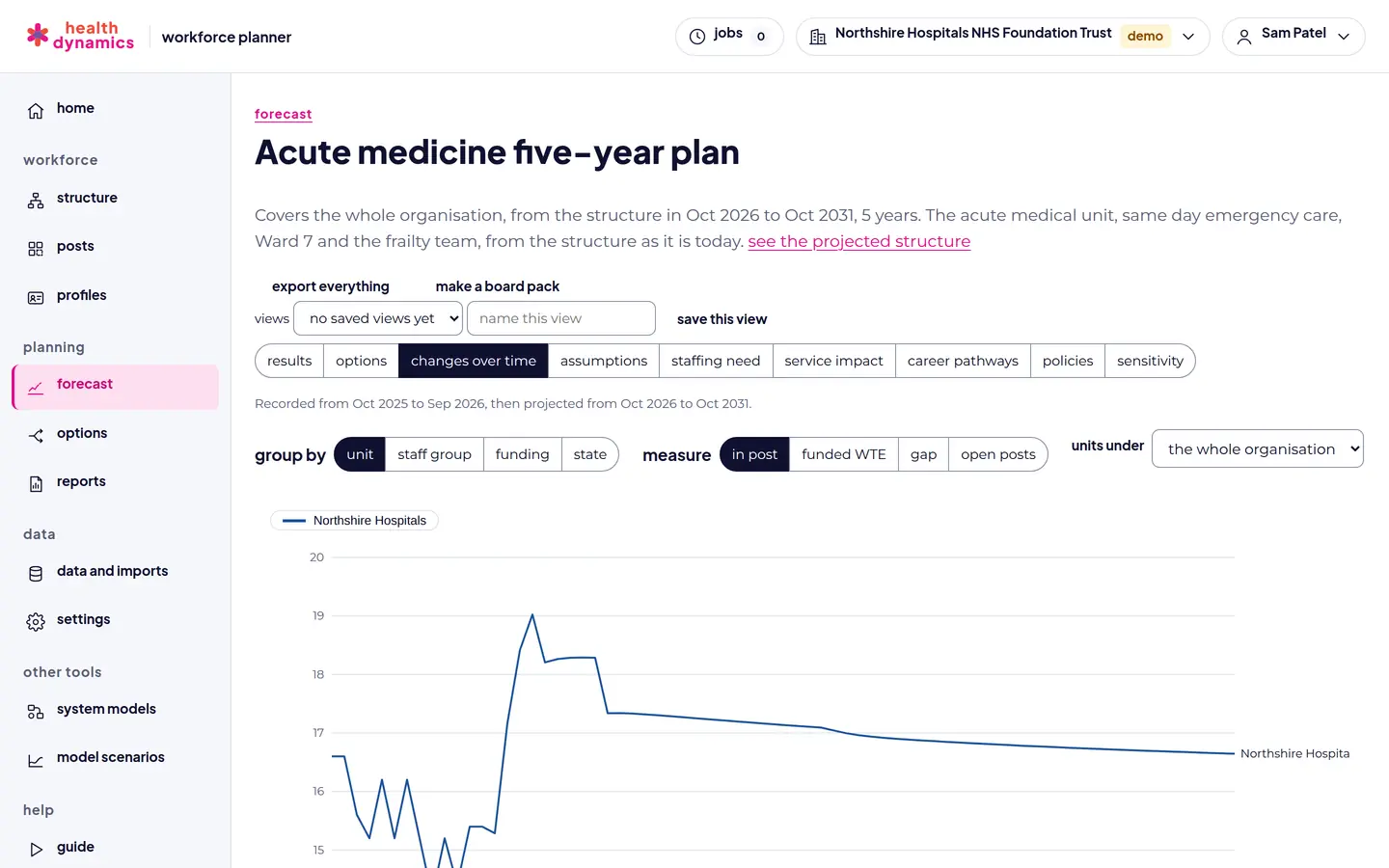
From a fictional organisation, with illustrative figures.
Health Dynamics already works with universities and colleges on workforce planning, bespoke courses for university-hosted health and care academies, and labour market research (see our education work). Our understanding of your sector comes from three places.
Education trains the health and care workforce. Nurses, midwives, allied health professionals, doctors, social workers, and care staff all start in a university or college. We model those training pipelines for health and care organisations: how many places are commissioned, how many students complete, how long they take to qualify, and where they go to work. We understand the demand for your health and care courses from the side of the employers who rely on them.
Your labour market challenges are the ones we work on. Health and care, like education, compete with other employers for scarce skills, lose experienced staff to retirement, struggle with retention and workload, and have to plan years ahead for people who take years to train. Workforce Planner was built to show how those pressures play out over time, post by post and month by month, whatever the sector.
Your demand follows the population, as health care does. We forecast demand for health services from ONS population projections by age. The same projections show how many school leavers and working-age adults your area will have, and the number of 18-year-olds in England is projected to rise to around the end of this decade and then fall. Planning teaching staff for a rise followed by a fall, alongside changes in international recruitment and adult learning, is exactly the kind of shift a month-by-month forecast handles better than a spreadsheet.
Workforce Planner works with your own structure, not a health one: name the levels of your unit tree (faculty, school, department, team), load your posts with their grades, staff groups, and funding (including externally funded research posts with their end dates, and posts hosted for partners), add your pay spine as a rate card, and set your own role profiles and competencies. Fixed-term contracts, funding ending, and retirement are all part of the forecast, and subjects or courses can drive demand through the demand layer, which already holds ONS population projections.
The free demo allows up to 50 posts: enough to load a department or team and try every step. A paid licence is priced for your organisation and includes a service level agreement and analytics support, and universities, colleges, and other academic organisations qualify for up to 35% off. Academics, researchers, and students can use the demo for research and study through their university or college's account.
Whether you want to plan your own workforce, develop courses with us, or understand how the labour market for your graduates is changing, tell us what you are working on.